


About
52+ Years of Technology Leadership | Former Chief Data Privacy Officer | Fortune 500 Executive | Award-Winning Musician
Speaking & AI Leadership
The Truth About AI Starts With the Truth About Your Data
Peter Gallinari
Former Chief Data Privacy Officer • Executive AI Governance Leader • Award-Winning Musician • Author
Helping executive leaders, boards, government agencies, healthcare organizations, universities, and technology professionals build trusted AI through trusted data.
Available for:
-
Keynote Presentations
-
Executive Briefings
-
Board Education
-
AI Governance Workshops
-
Conferences & Panel Discussions
Featured Topics
-
The Truth About AI Starts With the Truth About Your Data
-
AI Didn't Fail Us—We Failed AI
-
Building AI Governance That Actually Works
-
Building Privacy Programs That Deliver Business Value

Rockin Data Privacy: The Truth About Your Data: What Organizations Aren’t Telling You — And How to Fix Itby Peter Gallinari (Author) Format: PaperbackIn today's digital world, organizations collect enormous amounts of personal and sensitive data — often without fully understanding where it resides or how it is protected.In Rockin Data Privacy, cybersecurity veteran
Peter Gallinari draws on more than five decades of real-world experience across financial institutions, healthcare systems, and government organizations to reveal the hidden realities of modern data governance.
This book explores the structural challenges organizations face in protecting information, including data discovery, classification failures, access control issues, vendor risk, and the growing impact of artificial intelligence.Through practical examples and real-world scenarios, Gallinari introduces a governance framework built on four critical pillars:• Data Discovery• Data Classification• Data Privacy• Data Security Rather than focusing only on technology,
Rockin Data Privacy highlights the leadership, governance, and accountability required to responsibly manage data in today's complex digital environments.This book is essential reading for executives, cybersecurity professionals, privacy leaders , and anyone interested in understanding how organizations can better protect the information entrusted to them.
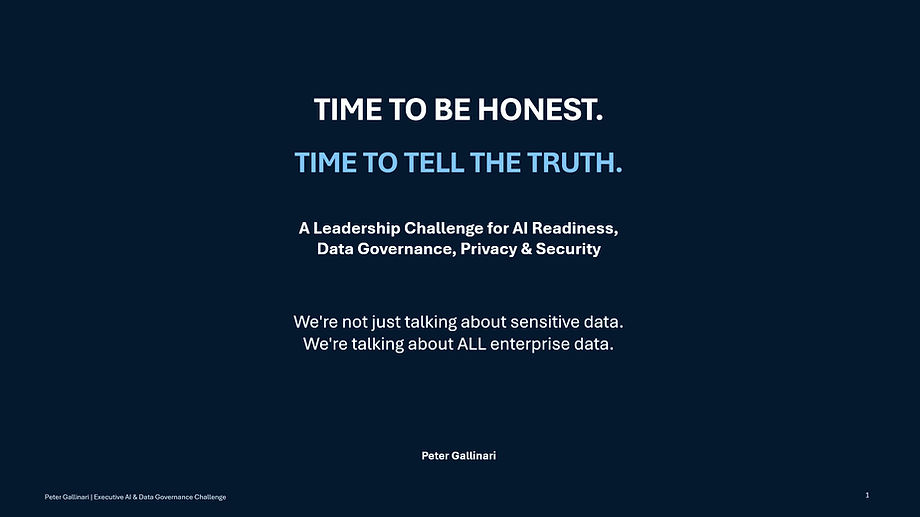
TIME TO BE HONEST
ROCKIN WITH DATA PRIVACY
BUILDING A DATA PRIVACY PROGRAM
Peter Gallinari is a seasoned professional with over 50 years of experience in Information Technology, including more than 30 years in leadership roles specializing in Data Privacy, Cybersecurity, and Compliance. He brings extensive cross-industry expertise spanning financial services, healthcare, and government, with a proven track record of developing and leading governance programs that protect sensitive data in complex, high-stakes environments.
Throughout his distinguished career, Peter has held several high-profile positions, including:
-
Chief Data Privacy Officer, State of Tennessee
-
Domain Information Security Officer, State of Tennessee
-
Chief Security Officer, GE Capital
-
GE IT Director of Operations
-
Chief Security Officer, overseeing security for three hospitals in New York
-
Assistant Vice President (AVP) of Delivery Services, Merrill Lynch
-
Data Privacy Program Manager, State of North Carolina
Peter has deep regulatory and compliance expertise across GLBA, SOX, HIPAA, FERPA, FTI, CJIS, SSA, PCI, and the EU GDPR, along with strong alignment to leading security and data protection frameworks, including ISO 27001, SOC 2 Type II, HITRUST and NIST.
In addition to his broader governance work, Peter has developed a growing body of articles and guidance focused on Artificial Intelligence (AI) risk, privacy impacts, and security governance. He specializes in helping organizations assess AI-enabled solutions—such as Microsoft 365 Copilot and agentic AI capabilities—to determine their risk level prior to implementation, reduce exposure to unintended sensitive data disclosure, and strengthen enterprise readiness through practical, scalable governance controls.
Peter is a recognized subject matter expert in cloud compliance and governance solutions, and is a frequent keynote speaker at Data Privacy and Cybersecurity conferences across both the public and private sectors. He is also the author of The Sound of Governance: Rockin’ Privacy Across Sectors (available on Amazon) and his latest book: Rockin Data Privacy - The Truth About Your data (What your not being told) and the creator of the weekly YouTube channel Rockin Data Privacy, where he covers modern privacy, security, and AI governance challenges in an approachable, real-world format.

Mission
In today's rapidly evolving digital landscape, organizations face an increasingly complex challenge: understanding, governing, protecting, and responsibly using their data.
For more than five decades, I have worked across technology, security, privacy, compliance, governance, healthcare, finance, and government, helping organizations navigate the realities behind managing sensitive information. Throughout that journey, one lesson has remained constant: organizations cannot effectively protect, secure, or leverage data they do not fully understand.
My mission is to help leaders bridge the gap between strategy and execution by providing practical guidance on data governance, privacy, cybersecurity, risk management, and responsible AI adoption. While laws, regulations, and compliance requirements are important, successful programs require much more than policy documents. They require operational processes, accountability, data visibility, and a culture of trust.
Whether discussing privacy, security, governance, or artificial intelligence, my focus remains the same:
-
Know your data.
-
Understand your risks.
-
Build trust through governance.
-
Enable innovation responsibly.
Because before AI, before security, and before compliance, there was always one fundamental question:
Do you truly know your data?
Vision
Technology continues to evolve at an unprecedented pace, yet many organizations still struggle with a fundamental challenge: understanding their data, managing risk, and establishing the governance necessary to support innovation responsibly.
Throughout my career spanning more than 52 years in technology leadership, I have observed that the greatest organizational risks are often not caused by a lack of technology, but by a lack of visibility, accountability, and understanding of the information organizations depend upon every day.
My vision is to create a practical educational resource that bridges the gap between theory and real-world execution. By combining industry experience, leadership lessons, governance principles, privacy practices, security strategies, and AI readiness concepts, this platform is designed to help leaders make informed decisions in an increasingly complex digital environment.
The goal is not simply to discuss compliance, privacy, security, or artificial intelligence as separate disciplines. The goal is to demonstrate how they work together to build trusted, resilient, and responsible organizations.
Whether you are a business leader, technology professional, privacy practitioner, security specialist, educator, student, or government official, these resources are intended to provide practical insights that can be applied across industries and organizational sizes.
As technologies continue to change, one principle remains constant:
Know Your Data. Understand Your Risks. Govern with Purpose. Innovate with Confidence.

FUNDAMENTAL COMPONENTS OF A DATA PRIVACY PROGRAM


My intent is to share the detail on these items on the left.
If there is a particular area that you would like more information on, please contact me from my contact page.
IS DATA PRIVACY JUST ABOUT LEGAL AND CYBERSECURITY?
No.
One of the most common misconceptions is that data privacy is solely the responsibility of legal teams or cybersecurity professionals. While both play critical roles, neither can successfully manage a privacy program alone.
Legal teams provide guidance on laws, regulations, contractual obligations, and compliance requirements. Cybersecurity teams implement technical safeguards designed to protect information from unauthorized access, misuse, or disclosure.
However, neither function typically owns the day-to-day operational activities required to manage a comprehensive privacy program.
Effective privacy programs require a dedicated operational framework that bridges business, legal, technology, security, compliance, and leadership. Privacy must be integrated into organizational processes, technologies, projects, and decision-making activities.
A successful privacy leader helps operationalize privacy by:
• Developing privacy governance frameworks and accountability structures
• Delivering privacy awareness, education, and training programs
• Conducting Privacy Impact Assessments (PIAs) and Privacy Threshold Assessments (PTAs)
• Identifying and managing privacy risks
• Supporting data discovery, classification, retention, and minimization initiatives
• Collaborating with legal, compliance, security, and business teams
• Assisting with incident response and remediation efforts
• Establishing metrics, reporting, and continuous improvement programs
• Supporting responsible AI and emerging technology governance initiatives
Privacy succeeds when legal, security, governance, and operational teams work together toward a common objective: protecting information while enabling the organization to achieve its mission.
In my experience, the most successful programs recognize a simple truth:
-
Legal interprets the requirements.
-
Security protects the environment.
-
Privacy operationalizes the program.
-
Leadership establishes accountability.
When these functions work together, organizations build trust, reduce risk, and create a stronger foundation for innovation.
Explore Additional Topics
The digital landscape continues to evolve, creating new challenges and opportunities for organizations across every industry. Through articles, presentations, educational resources, and leadership discussions, I explore a variety of topics designed to help organizations build trust, reduce risk, and prepare for the future.
Topics include:
• The Risks of Operating Without a Privacy Program
• Data Governance: The Foundation for Privacy, Security, and AI
• AI Governance and Responsible AI Adoption
• Evaluating the Effectiveness of AI Guardrails and Governance Controls
• Data Discovery and Classification: Do You Know Your Data?
• The Relationship Between Privacy, Security, and Compliance
• How Privacy Programs Differ Between Public and Private Sector Organizations
• The Critical Partnership Between the Data Privacy Officer and Chief Security Officer
• Privacy Impact Assessments (PIAs) and Risk Management
• Building Trust Through Transparency and Accountability
• Leadership Challenges in the Age of AI
• Why AI Didn't Fail Us — We Failed AI
While technology continues to evolve, one principle remains unchanged:
Trust is earned through accountability, transparency, and responsible stewardship of information.
As organizations collect, manage, share, and utilize increasing amounts of data, citizens, customers, patients, employees, and business partners expect their information to be handled responsibly.
"Data Privacy is a matter of trust. Citizens and consumers expect organizations to do the right thing with their information."
"Organizations that prioritize trust, transparency, and responsible data practices build stronger relationships, stronger reputations, and stronger foundations for innovation."
— Peter Gallinari

Welcome to My AI Education & Leadership Resource Center
Before You Deploy AI, Answer One Question:
Do you really know your data?
Most organizations are racing toward AI while still struggling to answer fundamental questions about data ownership, classification, governance, privacy, and security. The result is often an illusion of readiness.
These presentations challenge conventional thinking and explore the realities leaders must understand before placing AI on top of their organization's most valuable asset—its data.
Welcome to a different conversation about AI.
AI Policy / Guidance
AI IMPLEMENTATION & FRAMEWORK GUIDANCE
ON STAGE





Welcome to GDPR in Plain English
Understanding GDPR shouldn't require a law degree.
After more than five decades in technology, security, privacy, and governance leadership, I created this guide to help business leaders understand one of the world's most important privacy regulations—without the legal jargon.
Whether you're a CEO, CIO, CISO, privacy professional, security leader, business executive, or simply someone responsible for protecting personal information, this guide was written for you.
You'll find practical explanations, real-world examples, leadership insights, and actionable guidance designed to help you build stronger governance programs and prepare your organization for the future.
More importantly, you'll discover that GDPR isn't just about compliance. It's about earning trust.
Because every successful AI initiative, privacy program, and security strategy begins with the same foundation:
One Foundation. Two Outcomes.
Build the Foundation for AI, Privacy, Security, and Trust.
Thank you for visiting and thank you for choosing to invest in stronger leadership and better governance.
— Peter Gallinari
Former Chief Data Privacy Officer
Author • Speaker • AI & Data Governance Advisor
Download this document - Complimentary First Edition
GDPR IN PLAIN ENGLISH